
Ages 18 to 45
Vision options for ages 18–45
While your own lens still focuses well, the aim is to correct the refractive error without replacing the lens. That usually means laser treatment, or an implanted lens where the prescription is too high for laser treatment.
30+ years of experienceFree assessmentAn experienced treatment team throughout

Vision correction in your 20s and 30s
Between roughly 18 and 45, most people have a prescription that has settled. That stability is what makes this the period when laser and lens-based correction can be considered.
Short-sightedness (myopia), long-sightedness (hyperopia) and astigmatism are the conditions we most commonly treat in this age group. Which method may be relevant for you depends on factors including your prescription, the thickness and shape of your cornea, your tear film and your visual needs in everyday life.
Not everyone is suitable, and no single method is best for everyone. A thorough diagnostic examination is necessary to establish which treatment options may be relevant for you – or whether treatment is not recommended.
Treatment options for this age group
Four methods may be relevant for patients aged 18–45. At the assessment, we clarify which treatment options may be relevant for you.
Laser
ReLEx SMILE Pro
A flapless method performed through a 2–4 mm opening, using the Carl Zeiss VISUMAX 800. Because no corneal flap is created, the risk of complications related to a corneal flap is avoided.
Typically considered for: myopia, with or without astigmatism.
Laser
LASIK
In the treatment, a thin flap is created in the cornea, after which an excimer laser reshapes the tissue beneath it. LASIK is one of the most extensively documented refractive procedures and gives most patients a rapid visual recovery.
Typically considered for: myopia, hyperopia and astigmatism.
Laser
PRK / LASEK
A surface treatment that works on the outer layer of the cornea rather than creating a flap. Recovery takes longer than SMILE Pro or LASIK, but it remains an option where corneas are thinner.
Typically considered for: thinner corneas, or where a flap is not advisable.
Lens
ICL – implantable contact lens
A soft lens placed inside the eye in front of the natural lens, leaving the cornea untouched. It can be removed again if circumstances change.
Typically considered for: higher prescriptions, thinner corneas, or dry eyes.
Between 18 and 45: Laser treatment or ICL lens
to correct refractive errors
You will feel well informed, safe and secure with us
Short-sightedness with or without astigmatism
Our laser treatment for short-sightedness and astigmatism is gentle and takes only about 20 minutes. We offer ReLEx SMILE, FS-LASIK, PRK and LASEK, as well as implantable ICL lenses. In an ICL treatment, an artificial lens is placed in front of the eye's natural lens to correct the refractive error.
Long-sightedness with or without astigmatism
Our laser treatment for long-sightedness and astigmatism is gentle and takes only about 20 minutes. We offer FS-LASIK and implantable ICL lenses. In an ICL treatment, an artificial lens is placed in front of the eye's natural lens to correct the refractive error.
Comparing the methods
A simplified overview. Individual suitability and recovery vary, and your surgeon will discuss what applies to you.
| Method | How it works | Often considered for | Typical return to work |
|---|---|---|---|
| SMILE Pro | Lenticule removed through a small keyhole opening; no flap | Myopia, astigmatism, active lifestyles | 1–3 days |
| LASIK | Corneal flap lifted, tissue reshaped beneath | Myopia, hyperopia, astigmatism | 1–2 days |
| PRK / LASEK | Surface layer treated directly, no flap | Thinner corneas | Up to about a week |
| ICL | Lens implanted in front of the natural lens | Higher prescriptions, thin corneas, dry eyes | 1–3 days |
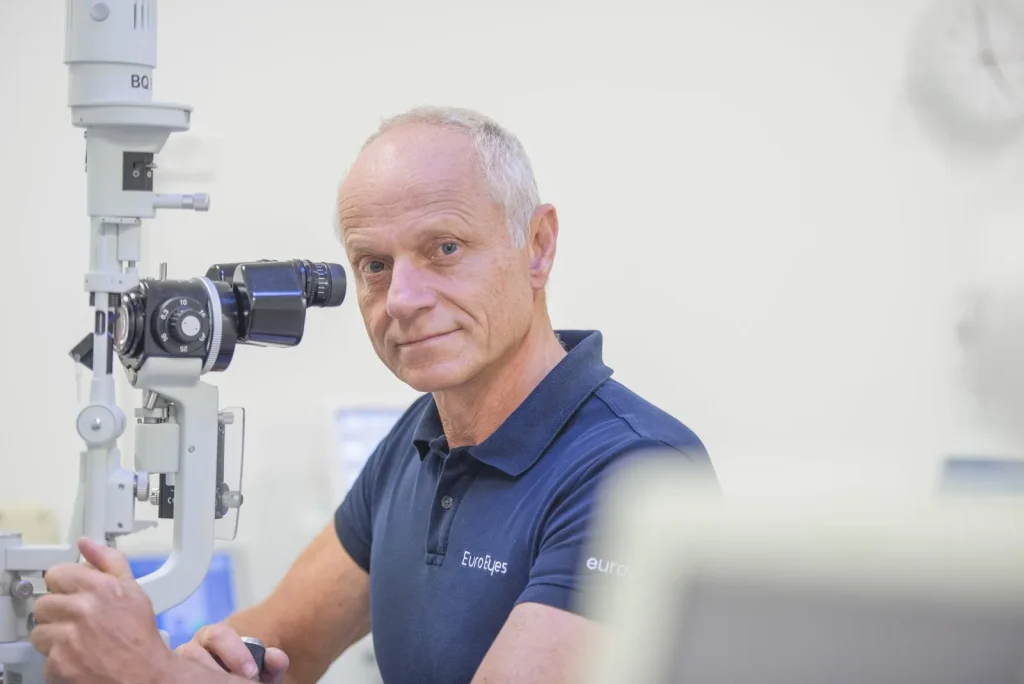
Are you likely to be suitable?
These are general indicators only. Suitability is determined by clinical examination, not by a checklist.
Often suitable if:
- You are over 18
- Your prescription has been stable for at least 12 months
- Your eyes are otherwise healthy
- You have realistic expectations of the outcome
Often not suitable if:
- Your prescription is still changing
- You are pregnant or breastfeeding
- You have keratoconus or another corneal condition
- You have untreated eye disease or severe dry eye
What the process involves
Free assessment
A full diagnostic examination of your eyes, lasting around 1–2 hours. You will be told if you are not suitable.
Discussing options
You receive a thorough explanation of which methods may be relevant for you, what each involves and the risks associated with them.
Treatment day
Performed under anaesthetic drops, around 15 minutes per eye. Most patients feel little or no discomfort.
Follow-up
Scheduled check-ups are included in the treatment price, so we can monitor your healing.
Risks and limitations
All surgery carries risk. These procedures are well established, but you should understand the following before deciding.
- Temporary dry eyes, glare or halos around light sources are common in the first weeks and usually settle.
- A small proportion of patients need an enhancement procedure to fine-tune the result.
- Correction does not stop your eyes ageing. Most people still develop presbyopia from around their mid-40s and may need reading glasses.
- Serious complications are uncommon but possible, including infection or a lasting reduction in vision quality.
- Results vary between individuals. No specific outcome can be promised in advance.
You receive a thorough explanation of the risks relevant in your particular case and with the proposed method. You then have time to consider your options before deciding.
Why choose EuroEyes?
An experienced treatment team
You are accompanied by our experienced team throughout – from the assessment to the final follow-up check.
Treatment volume
More than one million eyes treated across the EuroEyes group worldwide.
Aftercare included
Scheduled follow-up checks are included in your all-inclusive treatment price.
Advanced technology
We use advanced, modern technology for eye treatment.
Peace of mind and quality
We offer a lifelong peace-of-mind guarantee on treatments performed at EuroEyes.
Award-winning expertise
Our surgeons are Europe's most experienced experts in trifocal lens implantation.
Learn more at our free webinars and information evenings
We regularly hold information evenings and webinars where our eye doctors explain the treatments at EuroEyes and answer questions.

“Many patients describe the moment afterwards as a quiet shift – simply waking up and seeing the world clearly, without reaching for glasses or lenses.”Dr. Jørn Slot Jørgensen – Founder, Medical Director and CEO of EuroEyes
What our patients say
Independent reviews collected by Trustpilot.
697 reviews on Trustpilot
Reviews on Google
Frequently asked questions
What age can I have laser vision correction?
From 18, provided your prescription has been stable for at least 12 months. Stability matters more than age – if your prescription is still changing, treatment is usually postponed.
How do SMILE Pro and LASIK differ?
In LASIK, a thin corneal flap is created, after which the tissue beneath it is reshaped. In SMILE Pro, a small disc of tissue is removed through a 2–4 mm opening without creating a flap. This avoids the risk of complications related to a corneal flap. Both methods are well documented. Which method may be relevant for you depends on factors including your prescription and cornea.
Will I still need reading glasses later?
Most likely, yes. Laser correction treats your current prescription but does not prevent presbyopia, the age-related loss of near focus that affects almost everyone from around the mid-40s. Lens-based options exist at that stage.
Does the treatment hurt?
Before the treatment, you are given local anaesthetic eye drops. Most people therefore feel little or no discomfort during the treatment itself. Mild grittiness or watering for a few hours after the treatment is common.
How long until I can drive or exercise?
Most patients return to work within a few days. You may drive again once a check-up has confirmed that your vision meets the legal standard. As a rule, you will need to wait a few weeks before swimming and contact sports.
What does it cost?
The price depends on the treatment method and your prescription, and is confirmed in writing at your free assessment. See our pricing page for guide prices. We offer interest-free financing, and you will receive full details at the assessment.
Ready to see clearly?
Book a free, no-obligation assessment at your nearest EuroEyes clinic.