
Refractive error
Astigmatism
The cornea is shaped more like a rugby ball than a football. As a result, light focuses at several points instead of one, and vision can be unclear at every distance. Astigmatism often accompanies short- or long-sightedness and can be corrected at the same time.
30+ years of experienceFree assessmentAn experienced treatment team throughout

What is astigmatism?
Astigmatism means the cornea, or occasionally the lens inside the eye, is shaped more like a rugby ball than a football. Light is focused at more than one point instead of a single point on the retina, so vision is blurred or distorted at all distances rather than only near or far.
Astigmatism is very common, is usually present from birth and frequently occurs alongside short- or long-sightedness. Mild astigmatism may cause no symptoms, while more pronounced astigmatism can affect vision throughout the day.
Astigmatism often occurs together with other refractive errors, such as short-sightedness or long-sightedness, and can cause visual disturbances. Astigmatism can be corrected with glasses or contact lenses and, in many cases, treated with modern laser technology.
EuroEyes’ eye doctors have extensive experience and use modern equipment and treatment techniques.
Symptoms of astigmatism
Common signs include:
- Blurring or distortion at all distances
- Squinting to bring detail into focus
- Eye strain or headaches, particularly after close work
- Streaking or flaring around lights at night
- You have difficulty seeing clearly when you drive in the dark
If you recognise several of these signs, an eye examination can establish the cause.

What causes astigmatism?
Astigmatism arises because the curvature of the cornea is uneven and steeper along one axis than the other. The condition is usually present from birth, can be hereditary and typically changes little over time. In rarer cases, astigmatism develops after an injury, an eye operation or a corneal condition such as keratoconus.
How astigmatism occurs
The normal-sighted eye
A normal-sighted eye forms sharp images on the retina, giving clear vision both at a distance and close up. The eye's optical system – the cornea, the lens and the vitreous body – refracts incoming light rays so that they converge precisely on the retina. In this way, a sharp image is formed at all distances.
Over 45: Lens exchange
In a lens exchange, the eye's natural lens is replaced with an artificial lens. Multifocal and trifocal lenses can correct vision at several distances.
A monofocal lens corrects vision at one particular distance: close up, at intermediate range or at long range.
How we treat astigmatism
Which treatment may be relevant depends on your individual measurements and your visual needs. At the free assessment for eye treatment, we clarify your options.
Before any treatment, we carry out a thorough assessment with the relevant measurements. If you are under 45, we look at the options for laser treatment, among other things. If you are over 45, a lens exchange may be relevant. The examination forms the basis of our recommendation, and if the treatment first considered is not relevant, we go through any alternative options with you.
ReLEx SMILE Pro
A flapless laser method that reshapes the cornea through a small opening, correcting astigmatism together with short-sightedness.
Typically considered for: Astigmatism with myopia.
Treatment range: Laser treatment, ages 18–45. Short-sightedness up to −8 D. Astigmatism up to 5 D.
LASIK
Laser correction tailored to the specific axis and degree of your astigmatism, smoothing the corneal curvature.
Typically considered for: Astigmatism with myopia or hyperopia.
Treatment range: Laser treatment, ages 18–45. Short-sightedness up to −8 D. Long-sightedness up to +5 D. Astigmatism up to 5 D.
Toric ICL
An implantable lens made to correct astigmatism and short-sightedness together, leaving the cornea untouched.
Typically considered for: Higher prescriptions or thinner corneas.
Treatment range: Implantable contact lens for people aged 18 to 45. Short-sightedness up to −18 D, long-sightedness up to +10 D and astigmatism up to 6 D.
PRK / LASEK
A surface laser treatment without a flap, applicable where corneas are thinner.
Typically considered for: Thinner corneas.
Treatment range: Laser treatment, ages 18–45. Short-sightedness up to −6 D. Astigmatism up to 3 D.
What the process involves
Free assessment
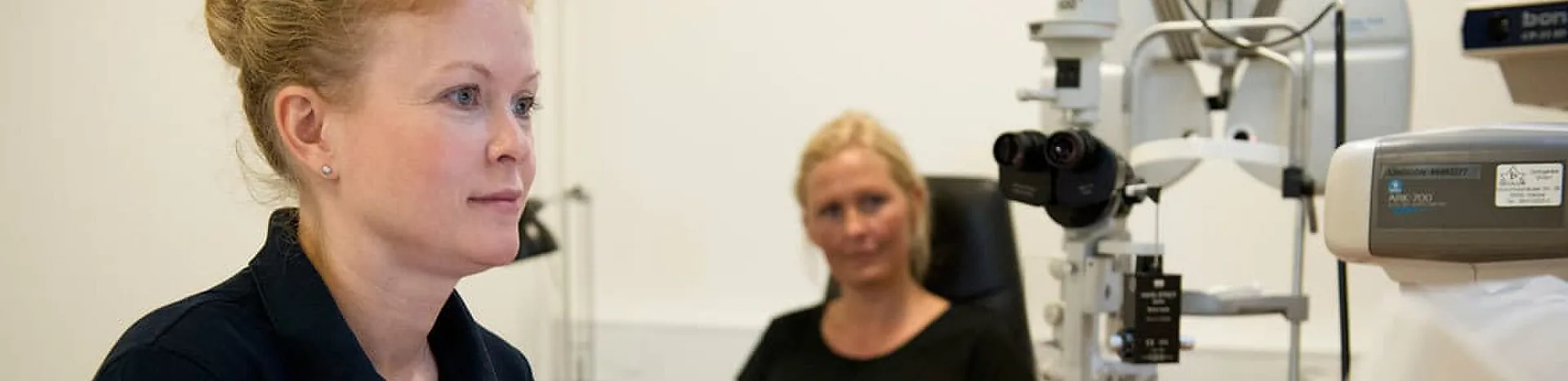
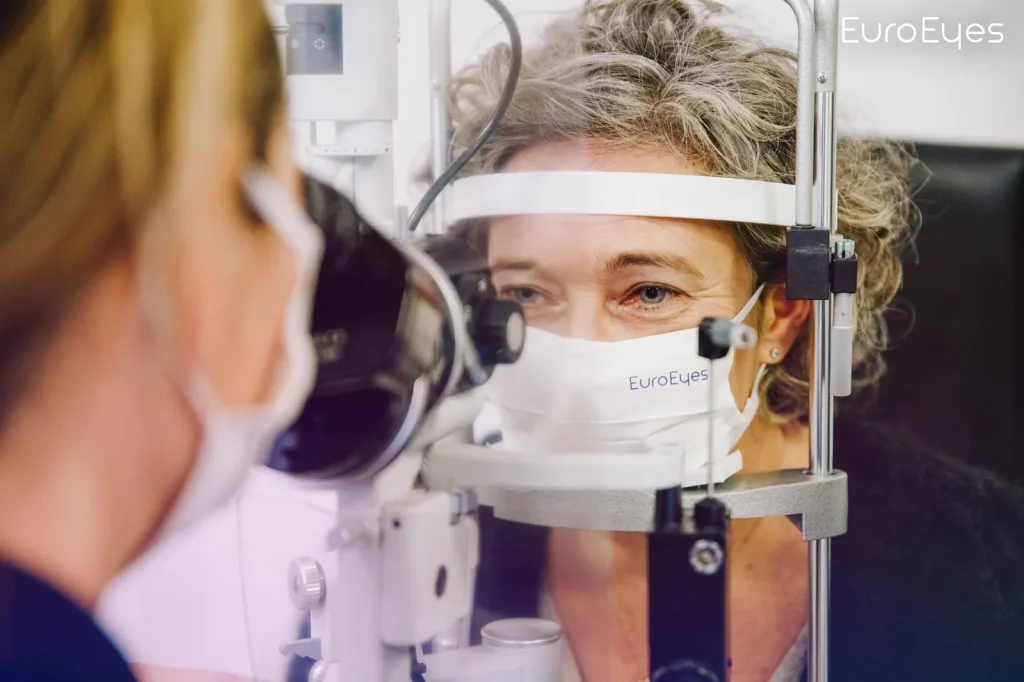
A thorough, free assessment for eye treatment lasting around 1–2 hours. Based on the examination, we clarify which treatment options may be relevant for you.
Your options
Our experienced treatment team goes through which methods may be relevant for you, what they involve and the risks associated with them.
Treatment
The treatment is carried out with local anaesthetic drops and takes around 15 minutes per eye. Most patients therefore feel little or no discomfort.
Follow-up
Scheduled check-ups are included in your all-inclusive treatment price.
Why choose EuroEyes?
An experienced treatment team
You are accompanied by our experienced treatment team throughout – from the first examination to the final check-up.
Treatment volume
More than one million eyes have been treated at EuroEyes clinics worldwide.
Aftercare included
Scheduled follow-up checks are included in your all-inclusive treatment price.
Advanced technology
We use advanced, modern technology for eye treatment.
Peace of mind and quality
We offer a lifelong peace-of-mind guarantee on treatments performed at EuroEyes.
Award-winning expertise
Our eye doctors have extensive experience in laser and lens treatments.
Learn more at our free webinars and information evenings
We regularly hold information evenings and webinars where our eye doctors explain the treatments at EuroEyes and answer questions.

“Many patients describe the moment afterwards as a quiet shift – simply waking up and seeing the world clearly, without reaching for glasses or lenses.”Dr. Jørn Slot Jørgensen – Founder, Medical Director and CEO of EuroEyes
What our patients say
Independent reviews collected by Trustpilot.
697 reviews on Trustpilot
Reviews on Google
Expert care at EuroEyes

Frequently asked questions
Is astigmatism a disease?
No. It is a variation in the shape of the cornea, present in some degree in most eyes. It only warrants treatment when it affects your vision.
Can astigmatism be corrected with laser?
In most cases yes. Both SMILE Pro and LASIK can correct astigmatism, usually alongside short- or long-sightedness. For more pronounced astigmatism, a toric implantable lens may be a relevant option.
Will it get worse over time?
Astigmatism usually remains stable through adult life. A marked or rapid change can indicate a corneal condition such as keratoconus. That is one of the things we check for at the assessment.
Why do I see streaks around lights at night?
An uneven corneal surface scatters light rather than focusing it to a point, which is often most noticeable against headlights or streetlights in the dark.
Suitability guide
Which treatment options might be relevant for you?
Four quick questions for a first, no-obligation indication of which treatments may be relevant based on your answers.
Anonymous and non-binding. This is guidance, not a medical assessment or diagnosis.

Arrange your free assessment
Book a free, no-obligation assessment at your nearest EuroEyes clinic in Copenhagen, Aarhus or Aalborg.
Related to Astigmatism
Read more about our treatments for astigmatism, related eye conditions and the eye doctors who can help.