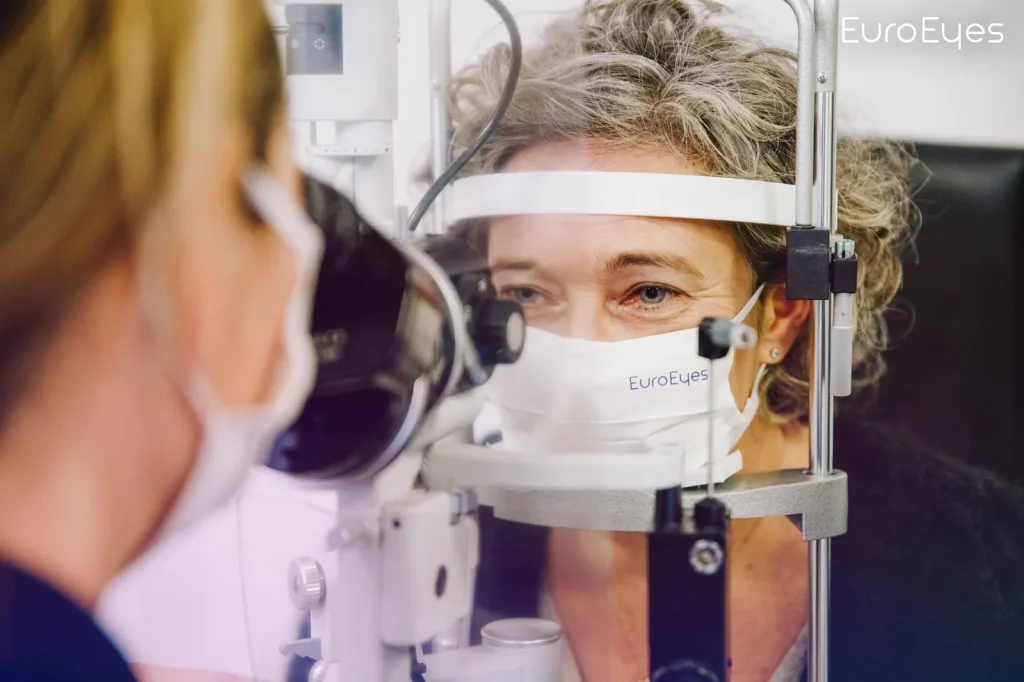
Laser eye surgery
PRK / LASEK
Surface treatments that are performed on the outermost layer of the cornea without creating a flap. That makes them a sound option for thinner corneas, and for people whose work or sport carries a risk of knocks to the eye. Recovery takes a little longer.
30+ years of experienceFree assessmentAn experienced treatment team throughout


What is PRK / LASEK?
PRK and LASEK are surface laser treatments that correct vision by reshaping the cornea without creating a flap. In the treatment, the very thin outermost layer of the cornea, the epithelium, is removed or loosened, after which an excimer laser reshapes the surface of the cornea. The epithelium regenerates naturally over a few days. PRK, LASEK and Trans-PRK can be alternatives if an FS-LASIK treatment is not relevant, for example with thin corneas. PRK can be used for short-sightedness of up to −6 dioptres and astigmatism of up to 3 dioptres. Vision improves gradually, and many people have good vision after one to two weeks.
As no flap is created, PRK and LASEK may be relevant for people with thin corneas or a very active lifestyle – for example in contact sports. The treatments can give precise results on a par with flap-based laser methods.
How PRK / LASEK works
Prepare the surface
The thin epithelial layer is gently loosened and moved aside to expose the cornea.
Reshape with laser
An excimer laser precisely reshapes the corneal surface to correct your prescription.
Natural healing
A protective contact lens is placed while the epithelium regenerates over a few days.
Treatment
Before a PRK laser treatment, you have a thorough eye examination and measurement with one of EuroEyes’ specially trained opticians. PRK and LASEK treat the surface of the cornea. In PRK, the epithelium – the outermost layer of corneal cells – is removed with a special instrument, while in LASEK the epithelium is loosened with an alcohol solution. In Trans-PRK, the epithelium is removed by laser. Unlike a LASIK treatment, no corneal flap is created. An excimer laser then reshapes the cornea according to the measurements taken at the assessment, so that light can be focused more sharply on the retina. After the treatment, a contact lens protects the cornea while the epithelium heals. This typically takes 3–5 days, while vision can take up to three months to stabilise. After PRK, effects can include halos in the dark, delayed healing of the epithelium and clouding of the cornea (haze).
Key benefits
No corneal flap
Ideal where a flap is not suitable.
For thin corneas
A relevant option for thin corneas.
Active lifestyles
Reassuring for contact sports and physical work.
Precise results
Equal accuracy to flap-based laser methods.
Short-sightedness and astigmatism
Effective for short-sightedness and astigmatism.
Long clinical history
One of the most established laser techniques.

Is this treatment right for you?
PRK/LASEK may be relevant if you have thin corneas or a lifestyle in which a flap-free treatment can be an advantage. At the assessment, we clarify which treatment may be relevant for you.
- You are over 20 with a stable prescription
- You have thinner corneas or a flatter cornea
- You lead an active life or play contact sports
- You are short-sighted or have astigmatism
- You are comfortable with a slightly longer recovery than LASIK
Between 18 and 45: Laser treatment or ICL lens
Treatments to correct refractive errors
Our laser treatments for short-sightedness and astigmatism are gentle, and the treatment itself typically takes around 20 minutes. In an ICL treatment, the refractive error is corrected with an artificial lens placed in front of your natural lens. For short-sightedness and astigmatism, relevant treatments can include ReLEx SMILE, FS-LASIK, PRK, LASEK or an implantable ICL lens. For long-sightedness and astigmatism, FS-LASIK or an ICL lens may be relevant. The right treatment is established at a free, no-obligation assessment.
Suitability guide
Which options might be relevant for you?
Four quick questions for a first, no-obligation indication of which treatments may be relevant based on your answers.
Anonymous and non-binding. This is guidance, not a medical assessment or diagnosis.
Recovery & aftercare
Recovery from PRK/LASEK takes a little longer than LASIK because the surface layer needs a few days to regenerate. A soft protective contact lens is worn for around 3–5 days, and your vision gradually sharpens over one to two weeks.
You will use antibiotic and lubricating eye drops as directed. The treatment team advises you on when you can return to work, sport and driving. At the follow-up checks, we monitor how your eyes are healing.
Why choose EuroEyes?
An experienced treatment team
You are accompanied by our experienced treatment team throughout – from the assessment to the final follow-up check.
Treatment volume
More than one million eyes have been treated at EuroEyes clinics worldwide.
Aftercare included
Scheduled follow-up checks are included in your all-inclusive treatment price.
Advanced technology
We use modern, advanced technology to examine and treat the eyes.
Peace of mind and quality
We offer a lifelong peace-of-mind guarantee on treatments performed at EuroEyes.
Award-winning expertise
Our surgeons are Europe's most experienced experts in trifocal lens implantation.
Learn more at our free webinars and information evenings
We regularly hold information evenings and webinars where our eye doctors explain the treatments at EuroEyes and answer questions.
“PRK and LASEK remain invaluable – for the right cornea, a flap-free surface treatment is the safest route to lasting clarity.”Dr. Jørn Slot Jørgensen – Founder, Medical Director and CEO of EuroEyes
Expert care at EuroEyes
What our patients say
Independent reviews collected by Trustpilot.
697 reviews on Trustpilot
Reviews on Google
Frequently asked questions
Why choose PRK/LASEK over LASIK?
It avoids creating a corneal flap, which can be safer for thinner corneas or people in contact sports.
Is the recovery longer?
Yes, recovery is a little longer than after LASIK. Vision stabilises gradually while the surface of the cornea heals.
Will it be uncomfortable?
You may feel some grittiness and light sensitivity for a few days; a protective lens and drops keep you comfortable.
Is the correction permanent?
The reshaping of the cornea carried out in the treatment is permanent. Vision can, however, change later in life, for example as a result of presbyopia.
When can I exercise again?
Light activity within a few days; your surgeon advises on contact sports and swimming.
How old can you be for a laser treatment?
As a rule, we offer laser treatment to people up to around the age of 50. From around the age of 45, presbyopia can affect which treatment is most relevant. We clarify this at a free, no-obligation assessment, where we can also advise on the option of trifocal lenses.
How long must my glasses prescription have been stable before a laser treatment?
Your glasses or contact lens prescription should normally have been stable for at least one year. If you are in doubt, we can measure your prescription and compare it with earlier measurements.
What is a LASEK operation?
LASEK is similar to PRK and may be relevant for correcting short-sightedness and astigmatism in people with thin corneas. In LASEK, the outermost cell layer of the cornea, the epithelium, is gently loosened with an alcohol solution before the cornea is treated with the laser. LASEK is not normally suitable for treating long-sightedness. Here, FS-LASIK may be an option. The relevant treatment is established at the assessment.
Can a laser eye treatment make you blind?
Serious complications after laser eye treatment are very rare. As with all operations, however, there is a risk of complications, which you will be thoroughly informed about before the treatment.
What is ReLEx SMILE?
ReLEx SMILE is a newer laser method that is gentle on the surface of the eye. The method can reduce the risk of dryness symptoms and infection.
What is LASIK?
LASIK is a well-proven laser eye treatment that has been used for decades. The name is short for laser in situ keratomileusis. In the treatment, an excimer laser reshapes the cornea. LASIK can be used in many cases of short-sightedness, long-sightedness and astigmatism.
Arrange your free assessment
Book a free, no-obligation assessment and find out if this treatment is right for you.
Related to PRK / LASEK
Read more about the conditions PRK/LASEK can correct, alternative treatments and our eye doctors.