Age-related change
Presbyopia
From the mid-forties the natural lens gradually stiffens and close focus becomes harder. Menus move to arm's length and small print needs more light. It affects everyone eventually, and a lens exchange addresses the cause rather than compensating for it.
30+ years of experienceFree assessmentMedical assessment and treatment

What is presbyopia?
Presbyopia is the gradual loss of the eye’s ability to focus on close objects. It is not a disease but a normal part of ageing, and it affects almost everyone eventually, usually becoming noticeable from around the mid-40s.
It happens because the natural lens inside the eye gradually becomes less flexible and can therefore no longer change shape as readily to focus up close. This is why many people come to need reading glasses – even if they have never needed vision correction before.
Sooner or later, virtually everyone experiences presbyopia to a greater or lesser degree. If you are over 45 and are having increasing difficulty reading at close range, it may be a sign of presbyopia.
Modern treatments can correct presbyopia and reduce the need for glasses and reading glasses. Depending on the treatment method, short-sightedness, long-sightedness and astigmatism can also be corrected. The treatment is carried out under local anaesthetic, and the experience varies from person to person.


Symptoms of presbyopia
Common signs include:
- Holding books, menus or your phone at arm’s length
- You have difficulty reading small print, especially in dim light
- Eye strain or headaches after close work
- Needing brighter light to read comfortably
- Near vision that gradually worsens over time
If you recognise several of these, a diagnostic eye examination will establish what is causing them.
What causes presbyopia?
The natural lens is flexible in youth, changing shape to focus at different distances. From around the age of 40 it progressively hardens and the surrounding muscle becomes less effective. This is a universal, gradual process, and it cannot be prevented.
We can treat presbyopia
Presbyopia cannot be treated or alleviated with medication or vision training. At EuroEyes, we offer a range of treatments that can correct presbyopia and reduce the need for glasses in everyday life.
One of the treatment options is trifocal lenses. They can also correct other existing refractive errors at the same time.
At the free, no-obligation assessment, we assess which treatment method may be relevant for you.
Over 45: Lens exchange
Our multifocal and trifocal lenses correct vision by replacing the eye's natural lens with an artificial lens.
A monofocal lens has a single focal point, which is typically set for vision at either near, intermediate or long range.
How we treat presbyopia
At the free assessment, we examine your eyesight and assess which treatment option may be relevant for you.
Trifocal lenses
An artificial lens with three focal points, giving vision at near, intermediate and far. Most patients become independent of glasses for daily life.
Typically considered for: Correction across all distances.
Treatment range: Lens treatment, ages 45+. Long-sightedness: All dioptres. Short-sightedness: All dioptres. Astigmatism: Up to 12 D.
EDOF lenses
Extended depth of focus lenses give a continuous range of vision. Some patients find night vision quality more natural.
Typically considered for: Patients who drive at night.
Clear Lens Exchange
The natural lens is replaced before any cataract has formed. Once the natural lens has been removed, a cataract cannot later develop in the treated lens.
Typically considered for: Presbyopia with long- or short-sightedness.
Refractive cataract surgery
If a cataract has begun to form, it is removed and your prescription corrected at the same time by the lens chosen.
Typically considered for: A developing cataract.
What the process involves
Free assessment
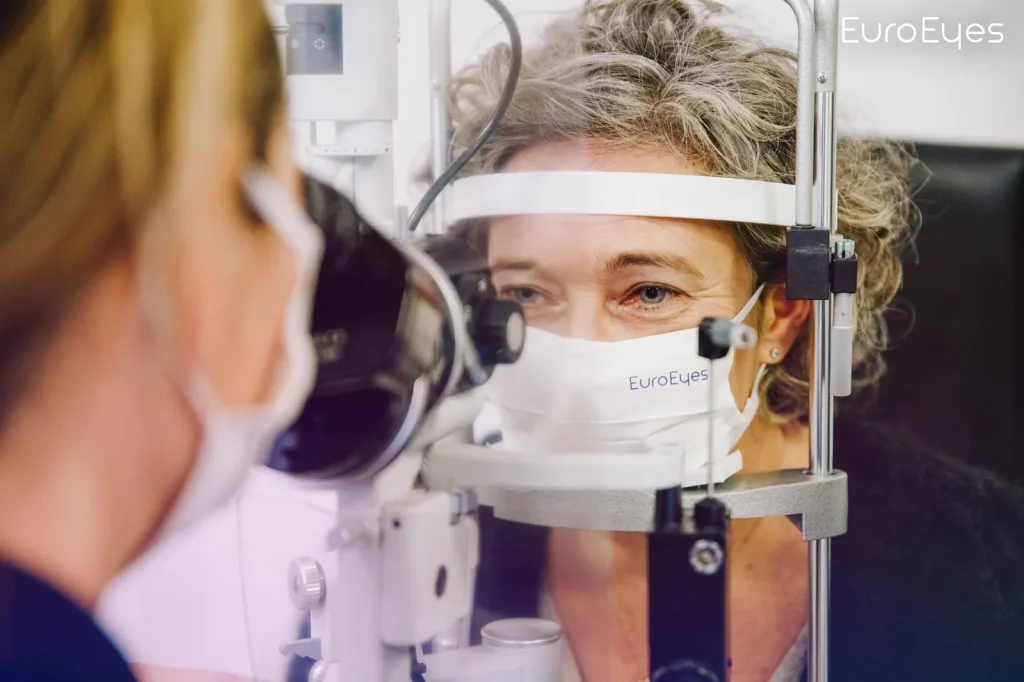
A thorough diagnostic examination lasting around 1–2 hours. Based on the examination, we go through the treatment options that may be relevant for you.
Your options
Our specialised team goes through which treatment methods may be relevant, what they involve and the risks associated with them.
Treatment
Under anaesthetic drops, around 15 minutes per eye. Most patients feel little or no discomfort.
Follow-up
Scheduled check-ups are included in your all-inclusive treatment price.
Why choose EuroEyes?
A specialised team
You will meet an experienced, specialised team throughout your course of treatment.
Extensive experience
At our clinics around the world, we have treated more than one million eyes.
Aftercare included
Scheduled follow-up checks are included in your all-inclusive treatment price.
Advanced technology
We use modern, advanced technology to examine and treat refractive errors.
Peace of mind and quality
We offer a lifelong guarantee on the treatment you have received, under the applicable guarantee terms.
Award-winning expertise
Our doctors have extensive experience in trifocal lens implantation.
Learn more at our free webinars and information evenings
We regularly hold information evenings and webinars where our eye surgeons explain the treatments at EuroEyes and answer questions.
“Many patients describe the moment afterwards as a quiet shift – simply waking up and seeing the world clearly, without reaching for glasses or lenses.”Dr. Jørn Slot Jørgensen – Founder, Medical Director and CEO of EuroEyes
What our patients say
Independent reviews collected by Trustpilot.
697 reviews on Trustpilot
Reviews on Google
Expert care at EuroEyes
Frequently asked questions
Can presbyopia be prevented?
No. It is a normal part of ageing that affects almost everyone, and nothing prevents or delays it. It can, however, be corrected.
Why does laser not treat presbyopia?
Laser reshapes the cornea, but presbyopia originates in the lens inside the eye. For that reason lens-based options are usually the relevant ones for this age group.
Will trifocal lenses end my need for reading glasses?
Most patients become independent of glasses for daily life, though some use light reading glasses for very fine print. Individual results vary and no specific outcome can be promised in advance.
Am I too young or too old for treatment?
Presbyopia treatment is usually considered from around 45. There is no strict upper age limit – suitability depends on the health of your eyes rather than your age.
Suitability guide
Which treatment might be relevant for you?
Four quick questions for a first, no-obligation indication of which treatments may be relevant for you.
Anonymous and non-binding. This is guidance, not a medical assessment or diagnosis.
Arrange your free assessment
Book a free, no-obligation assessment at your nearest EuroEyes clinic in Copenhagen, Aarhus or Aalborg.
Related to Presbyopia
Find the treatments we offer for Presbyopia, related conditions, and the surgeons who can help.